



.png?width=760&height=460&name=1%20(1).png)
- Many organizations have small spaces for a variety of reasons, from strategic budgeting to the local commercial real estate market to the rise of hybrid and remote workforces.
- Advantages may include saving on rent and a sought-after location, but it also comes with challenges. Fitting people, equipment, and furniture into the space and still allowing for a welcoming atmosphere for staff, clients, and visitors, room for growth without feeling crowded, and ample space for all the different types of tasks and projects.
- Learn top strategies and furnishing options that make the most of compact office spaces, and how Office Basics’ design and planning services can help.
Defining the Workspace and Style
Consider the type of work performed and typical atmosphere:
- Collaborative vs. quiet, individual work?
- Preplanned meetings on a schedule or more spontaneous brainstorming sessions?
- Frequent visitors and/or client meetings?
- Fast-paced environment with many projects at once?
- Ratio of in-office and remote or hybrid employees?
- Need for a reception or waiting area?
This will help you determine the different areas and priorities for the space. Examples: collaborative work benefits from an open-concept floor plan and tables for meetings, many client visits need a more formal meeting area that can be closed off in some way as necessary.
Learn About Our Design Services
Concepts and Strategies for Saving Space
Elements of design that make small spaces workable when square footage is at a premium.
Incorporate Sensory Cues
Includes things like natural materials/plants/natural light, colors, overhead, and task lighting. These de-emphasize a cold, sterile atmosphere that is largely outdated and makes workers feel cut off from the outside world. Choices can make a place more enjoyable to spend time in and create the illusion of more space and airflow.
Consider Scale
Keep furniture in scale with the space - avoid hulking or monolithic shelving or desk units, overly tall bookcases and partitions, other decor or furniture that blocks light, airflow, or creates a closed-off feel. Looks and feels more open and easier to rearrange to tweak the layout over time.
.png?width=760&height=460&name=1%20(2).png)
Designate Zones
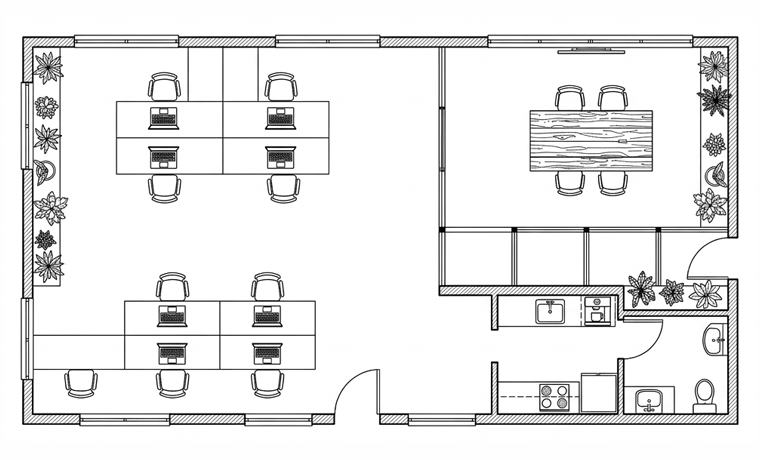
Designate set zones that align with the common tasks, with emphasis on doing them efficiently and with minimal “friction” that slows them down (i.e., clearing table decor in order to prepare documents, traveling to a different area of the space for frequently used supplies). Areas must be sized to the number of people who tend to need them:
- making copies and also assembling packets: add a table with space to sort and for stapler, paperclips, other supplies in a bin or built-in drawer,
- conference area with a wall-mounted screen and rolling chairs for easy meetings with remote workers, clients, etc.
- space with lots of lighting and table, and a whiteboard space for creative or visual tasks,
- quiet spaces with a table and comfortable seating, slightly removed for focused solo work,
- adequate, dedicated surfaces for dealing with incoming packages or files that need to be assessed
- Hot-desk areas with temporary or shared workstations that can be used by anyone as needed or by a designated group that rotates.
Create Intentional Storage
Make storage easy to access and easier to put away - less stress and encourages timely clean up and makes it easier to get started on large projects. It’s important to have storage solutions with enough room for the supplies and equipment needed but not so much overstock that it becomes crammed and disorganized quickly. Through our procurement services, we help organizations streamline office supply purchasing, inventory management, and replenishment so workspaces stay organized and productive.
Control Clutter
Items without designated homes quickly become clutter. Clutter can be distracting and contributes to stress, sense that work is never done, or space is just unsettled. Providing storage is important to combat clutter but so is culling items that aren’t needed and keeping things tidy in the office in general and at individual desks, and especially in shared spaces. Examples:
- Places to keep personal items while at work (purses, keys, other valuables, coats, lunches)
- cord management
- shelves and drawers and cabinets that allow for easy storage of frequently used items
Use Vertical Space
Adds storage while keeping surfaces clear and ready for use, easy to reset for next task or user of shared/communal space. Draws the eye upward and makes the area look larger or less cluttered. Use vertical/wall space - shelves, pegboard, fold down or pull out surface, hutched sections of desk.
Furnishings that Support Employees and Their Work
The next step is to select individual furnishings that meet the needs and goals you’ve identified. How they look and how they function, especially because generally using less furniture, or smaller pieces to accomplish goals.
Explore Small-Space Furniture Solutions
Desks
Desks take up the most space, so we have options that include the desk, storage drawers, and cabinets to keep supplies and tools organized at close at hand. Ergonomic and height-adjustable options are important for comfort in dedicated or shared workspaces.
The classic cubicle layout can be very space efficient ways to provide work space for multiple people along with privacy and storage. We also offer many different complete office systems to transform any commercial workspace design. These systems combine multiple desks into one unit, providing ample space in the office while still promoting productivity.
Many options for the layout including traditional rows of cubicles or U-shaped configuration or clustered desks with central hubs for collaboration. These can work well when grouped logically to keep collaborative teams in proximity.
Conference Tables
Conference tables are multifunctional, and can be used for meetings, large projects, creative work, or as temporary workspaces.
Seating
Most offices need a range of seating types and options: armchairs for visitor areas, desk chairs, task chairs, breakroom chairs, etc. We have options for different needs: casters, stackable, formal, lightweight, etc.
Furnish Your Small Space ASAP with Our Quick-Ship Solutions
Working Walls and Partitions
Modular glass office walls allow you to add separation between working environments without building physical rooms, which take up much more space. They are non-load-bearing interior walls that help divide a space for any number of employees without sacrificing floor space and light distribution. They also cut energy costs because they provide natural light to each office space and reduce the need for artificial or electric lighting systems.
Creates privacy without feeling closed-off or isolating, and adds a sound barrier that keeps loud discussions or group work from overwhelming the rest of the office.
Storage
Even in smaller, compact working environments, storage is crucial to prevent clutter and distractions to you, your employees, and your customers/clients. We offer many different storage options to keep your office organized without too much space.
Planning & Design Help for Offices of Any Size
We can help plan the right type of furniture and design your space to promote productivity and comfort. Especially for smaller spaces, it may be challenging to design and choose the right furniture to maximize the space without feeling crowded.
Describe design process:
- Consultation: We’ll take the time to understand your vision and company culture, analyze the floorplan and space, and determine what needs to be done.
- Brainstorm: Based on your feedback, our designers will prepare an initial furniture layout and invite you to tour our showroom to test out the furniture in person.
- Design concepts: We’ll produce 2D and 3D concepts with our furniture renderings and layouts and present a full scope of work and quotation based on the final design approval.
- Installation: We’ll start the installation process with our skilled team and provide you with any advice on electrical and data requirements to ensure a successful installation.
Office Basics Has Your Back
If your working environment is small, you can still turn it into a productive, engaging, and smart office space that gets the job done.


-1.png?width=157&height=117&name=Untitled%20design%20(1)-1.png)